Why You Forget Most of What You Read (and How Pictures Help You Remember)
A friend asks what that book you finished last month was about. You loved it. You stayed up late for it. And now all you can say is "it was really good, there's this guy, and... a boat?" If that sounds familiar, you're not a bad reader. You're a normal one.
Reading takes real time. Pew Research found that 23% of American adults hadn't read a single book in the past year, so if you're reading at all, you're already giving books hours that could have gone elsewhere. It's a shame to give those hours and keep so little. The good news is that memory research is pretty clear about why this happens, and about one of the simplest fixes: turn what you read into pictures.
Your brain is built to forget
In the 1880s, the German psychologist Hermann Ebbinghaus spent years memorizing lists of nonsense syllables and testing how fast they faded. He measured memory by how much effort he saved when relearning a list. Twenty minutes after learning one, he saved about 58% of the original effort. After one day, only about a third. The steepest drop happened in the first few hours.
That's the famous forgetting curve, and it isn't just an old curiosity. In 2015, researchers at the University of Amsterdam repeated the experiment with 70 hours of testing and got a curve very close to the original.
A novel isn't a list of nonsense syllables, of course. Stories have meaning, characters, and emotion, and all of that helps. But the basic shape holds. If you read a chapter on Tuesday night and don't touch the book until Sunday, most of the details are gone. We wrote about the same problem with notes in why we take notes: what you don't capture, you lose.
Pictures stick in a way words don't
Here's where it gets interesting. Our memory for images is far stronger than our memory for text. Psychologists call this the picture superiority effect, and some of the numbers are striking:
- 98% vs 90% In a classic 1967 study by Roger Shepard, people saw 612 pictures once and then had to pick each one out of a pair. They got it right 98% of the time. With words, they scored 90%, and with short sentences, 88%.
- 10,000 pictures In 1973, Lionel Standing pushed this further and showed people up to 10,000 pictures, each for only a few seconds. Days later they could still recognize a large share of them. His conclusion was that memory for pictures is "almost limitless" under the right conditions.
- 13 out of 13 Richard Mayer, who has studied multimedia learning for over three decades, found that people who learned from words plus pictures did better on problem-solving tests than people who learned from words alone in all 13 of the experiments he reviewed. The typical improvement was large, the kind researchers rarely see.
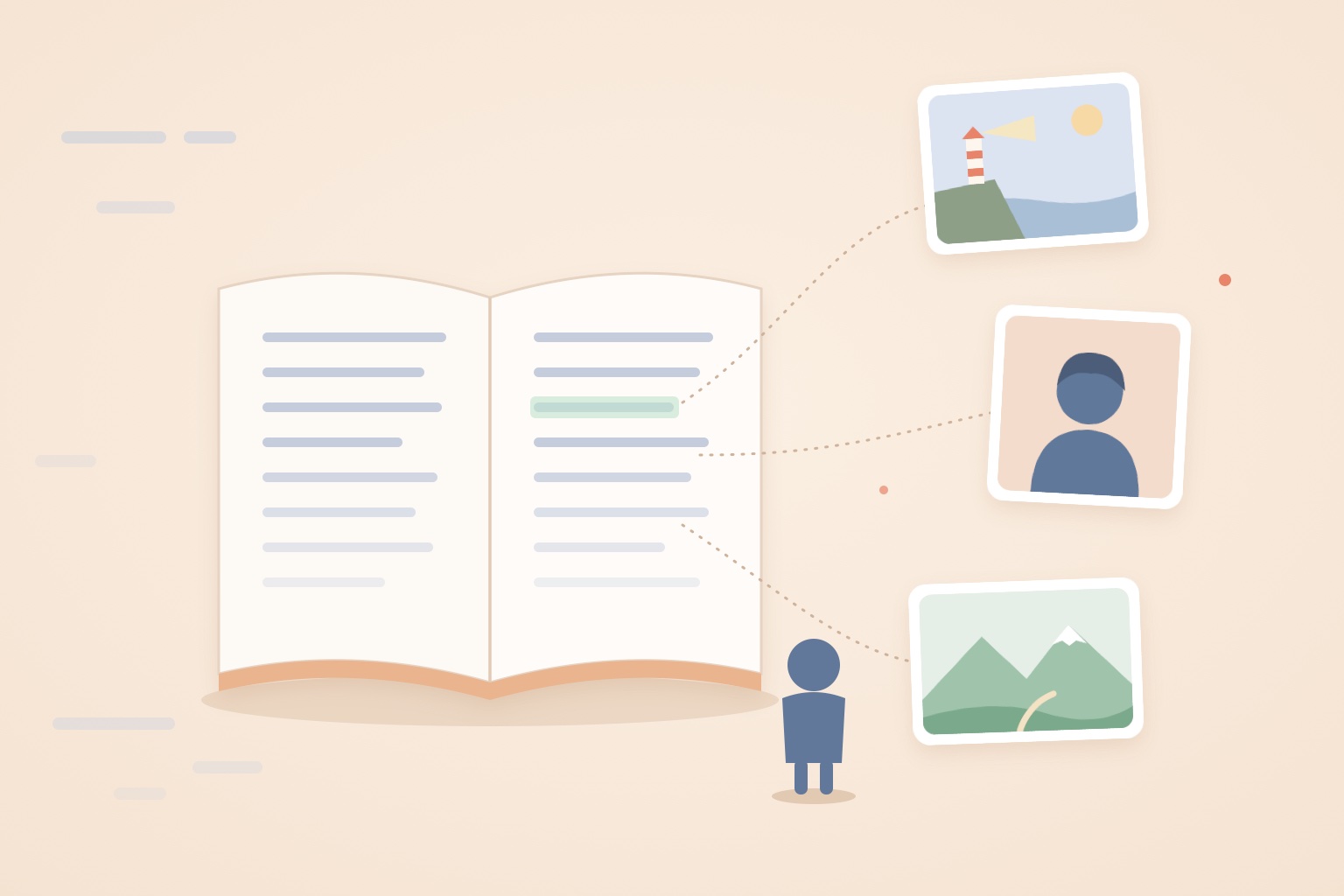
Why does this happen? One well-known explanation is dual coding theory, proposed by Allan Paivio. When you take in something as both words and an image, your brain stores it in two ways. Later, if one way fails, the other can still bring it back. A sentence about a lighthouse on a cliff is one memory. The image of that lighthouse is a second one, and it's usually the one that lasts.
A quick myth check:
You may have seen the claim that "the brain processes images 60,000 times faster than text." It gets repeated everywhere, but nobody has ever found a study behind it. You don't need it anyway. The real research above makes the case on its own.
Drawing beats rereading
Looking at pictures helps. Making them helps even more. In 2016, researchers at the University of Waterloo asked people to either write down or quickly draw a list of simple words like "apple." Participants often recalled more than twice as many of the words they drew. Artistic skill didn't matter. Stick figures worked fine.
The researchers' explanation is that drawing makes you think about what something means, what it looks like, and how to put it on paper, all at once. That builds a richer memory than writing the word or reading it again.
Reading teachers have known a version of this for a long time. When the U.S. National Reading Panel reviewed decades of research in 2000, graphic organizers (maps, timelines, and diagrams of a text) were one of only seven comprehension methods with solid scientific backing.
How to make a book stick
1. Picture the scene before you turn the page
At the end of a key scene, pause for ten seconds and picture it. Where are the characters standing? What's the light like? What's in the background? It feels slow at first, but you're creating that second memory dual coding talks about.
2. Sketch a character map
Big novels with lots of characters are where most of us get lost. Keep a single page with a small box for each character, a word or two about them, and lines showing how they're connected. Ugly is fine. Remember, the Waterloo study found that drawing skill made no difference.
3. Draw the shape of the story
When you finish a part of the book, draw a simple timeline or a rising-and-falling line of the plot with three or four labeled moments. This is a graphic organizer, the same tool the reading research backs. For nonfiction, a quick mind map of the main ideas works the same way.
4. Review the picture, not the pages
The forgetting curve is steepest in the first day, so a short review the next morning does more than a long one a week later. Glance at your sketch or map for a minute before you start the next chapter. It's much faster than rereading, and it refreshes the image, not just the words.
5. Write down what it meant to you
Pictures help you remember the story. A short note helps you remember why it mattered. When I finish a book I write a few lines in MindMirror: the idea that stuck, a scene I keep thinking about, and anything I want to try. A year later, searching "books" or a character's name brings it all back. That's a small gift to your future self.
What if you can't picture things?
Some people can't form mental images at all. It's called aphantasia, and studies estimate it affects somewhere around 1% to 4% of people. Many more simply find it hard to picture a scene from a description, especially when they're tired or reading on a phone during a commute.
For these readers, "just imagine it" isn't helpful advice. Outside pictures help a lot here: illustrated editions, graphic novels, maps at the front of fantasy books, and your own rough sketches. The memory benefit comes from having an image tied to the words. It doesn't have to come from your own imagination.
You don't remember a book by the words you read. You remember it by the pictures you leave behind.
So next time you start a book, keep a piece of paper or a notes app nearby. Picture one scene per chapter, sketch the cast, and take one minute the next day to look at what you drew. It's a small habit, and it's the difference between "it was good, there was a boat" and actually being able to tell someone why they should read it.
P.S. We liked this idea so much we built a reader around it. Storieta illustrates scenes as you read, keeps a portrait of every character so you never wonder "wait, who is this again?", and recaps the story so far without spoiling anything ahead. It also has full comic editions of classic books if you'd rather see the whole story drawn.
Share this post